
Introduction
An IPTV Headend is the technical heart of every IPTV service. It is the system that takes raw television signals — from satellite, cable, or terrestrial sources — and converts them into digital streams that can travel across IP networks to reach viewers on smart TVs, set-top boxes, and mobile apps.
For any IPTV provider, hotel, ISP, or enterprise network, the headend is not optional. It is the foundation that determines stream quality, channel reliability, and scalability. Without a properly designed IPTV Headend, even the best content library or app interface will fail to deliver a smooth viewing experience.
In this guide, we break down everything you need to know: what an IPTV Headend is, how it works, its architecture, the equipment involved, real-world use cases, costs, and the best solutions available in 2026.
Pro Tip: Think of the IPTV Headend as the “kitchen” of a restaurant. No matter how nice the dining room (your app or interface) looks, if the kitchen isn’t organized, the food (your video streams) will arrive late, cold, or wrong.
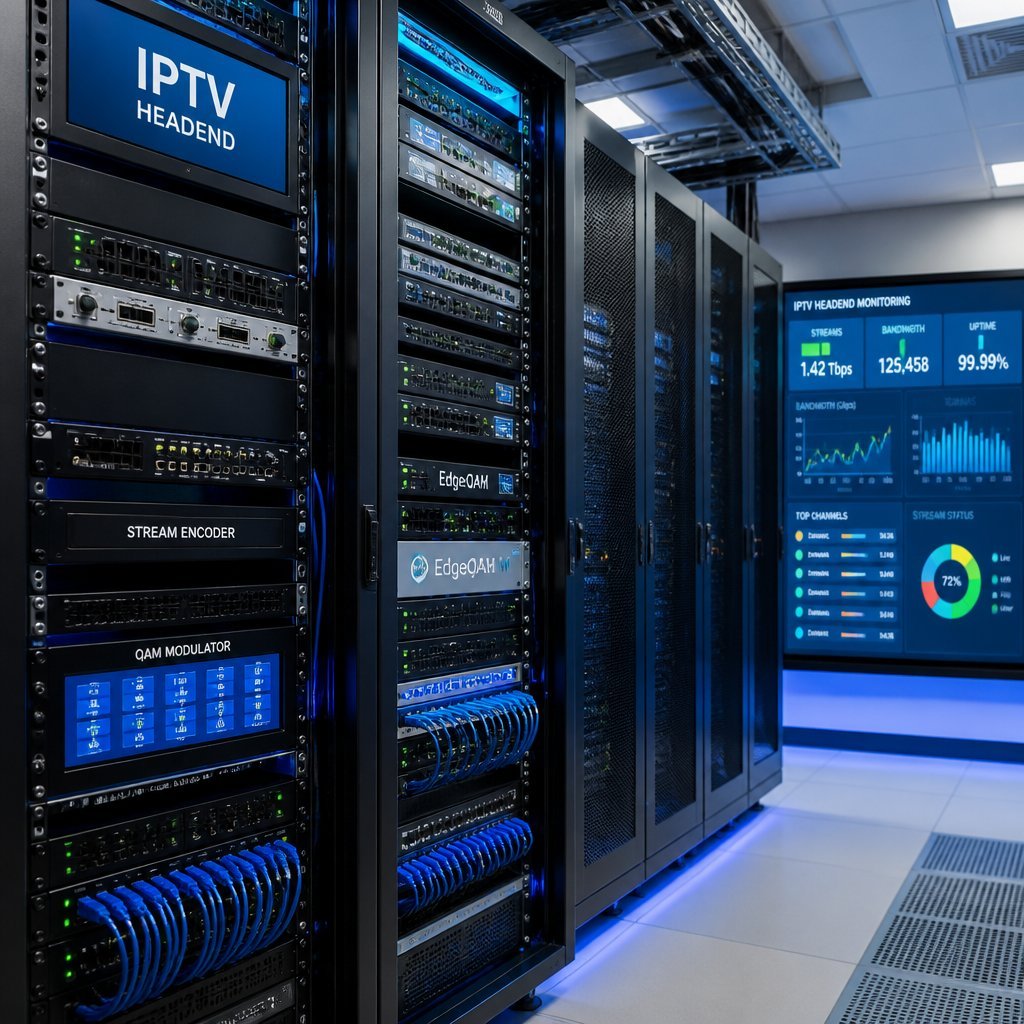
What Is an IPTV Headend?
An IPTV Headend is a centralized system of hardware and software that receives, processes, encodes, and distributes television content over an IP network. It acts as the bridge between traditional broadcast signals (satellite, cable, terrestrial) and modern IP-based delivery systems.
In simple terms, the IPTV Headend system:
- Captures live TV signals from various sources.
- Converts (encodes/transcodes) them into IP-friendly formats.
- Distributes them to viewers through multicast or unicast streaming.
This makes the headend essential for telecom operators, hotels, hospitals, universities, and any organization that wants to deliver live TV channels over a private or public IP network.
Why IPTV Headend Systems Matter
- They enable live TV distribution at scale.
- They support Video on Demand (VOD) alongside live channels.
- They allow content security through DRM and encryption.
- They ensure quality of service (QoS) across thousands of simultaneous viewers.
How Does an IPTV Headend Work?
An IPTV Headend works by following a structured signal chain. Understanding this workflow helps clarify why each component matters.
- Signal Reception – Satellite dishes, cable feeds, or terrestrial antennas capture raw broadcast signals.
- Demodulation – Signals are demodulated from their carrier frequencies into usable digital data (often MPEG-TS).
- Encoding/Transcoding – Raw video is compressed using codecs like H.264 or H.265/HEVC to reduce bandwidth needs.
- Multiplexing – Multiple channels are combined into manageable streams.
- Middleware Processing – Metadata, EPG (electronic program guide), and channel management are applied.
- Streaming Distribution – Content is pushed via multicast (for live TV) or unicast (for on-demand requests) across the network.
- Client Playback – IPTV clients (apps, set-top boxes, smart TVs) receive and decode the stream for viewing.
Pro Tip: Multicast is far more bandwidth-efficient for live channels because one stream serves many viewers simultaneously, whereas unicast creates a separate stream per user — ideal for VOD but expensive at scale for live TV.
IPTV Headend Architecture Explained
A well-designed IPTV Headend architecture consists of multiple interconnected layers, each with a specific job.
Signal Sources
These include satellite feeds, terrestrial broadcasts, cable TV inputs, and IP-based content feeds. The quality of the source signal directly affects the final viewer experience.
Satellite Receivers
Satellite receivers (often called IRDs — Integrated Receiver Decoders) capture signals from satellites and convert them into a usable digital format for further processing.
Encoders
IPTV Encoders compress raw video into standard formats such as H.264 or H.265/HEVC, drastically reducing file size while preserving visual quality — critical for efficient bandwidth usage across the network.
Transcoders
An IPTV Transcoder converts already-compressed video from one format or bitrate to another, allowing compatibility with different devices, screen resolutions, and network conditions (adaptive bitrate streaming).
Middleware
IPTV Middleware manages the user-facing side: EPG, channel lists, subscriber authentication, billing integration, and content management. It’s the software layer that connects the backend infrastructure to the viewer’s interface.
Streaming Servers
IPTV Streaming Servers handle the actual delivery of content, managing multicast/unicast sessions, adaptive bitrate streaming (HLS, DASH), and load balancing across the network.
Storage
Storage systems retain VOD libraries, recorded content (nDVR/cloud DVR), and time-shifted TV, often using scalable network-attached storage (NAS) or cloud-based solutions.
DRM
Digital Rights Management (DRM) protects premium content from piracy through encryption and license management, ensuring only authorized subscribers can decode streams.
CDN
A Content Delivery Network (CDN) distributes IPTV content across geographically dispersed servers, reducing latency and buffering by serving viewers from the nearest edge node.
IPTV Clients
These are the end-user devices — set-top boxes, smart TV apps, mobile apps, and web players — that decode and display the final stream.
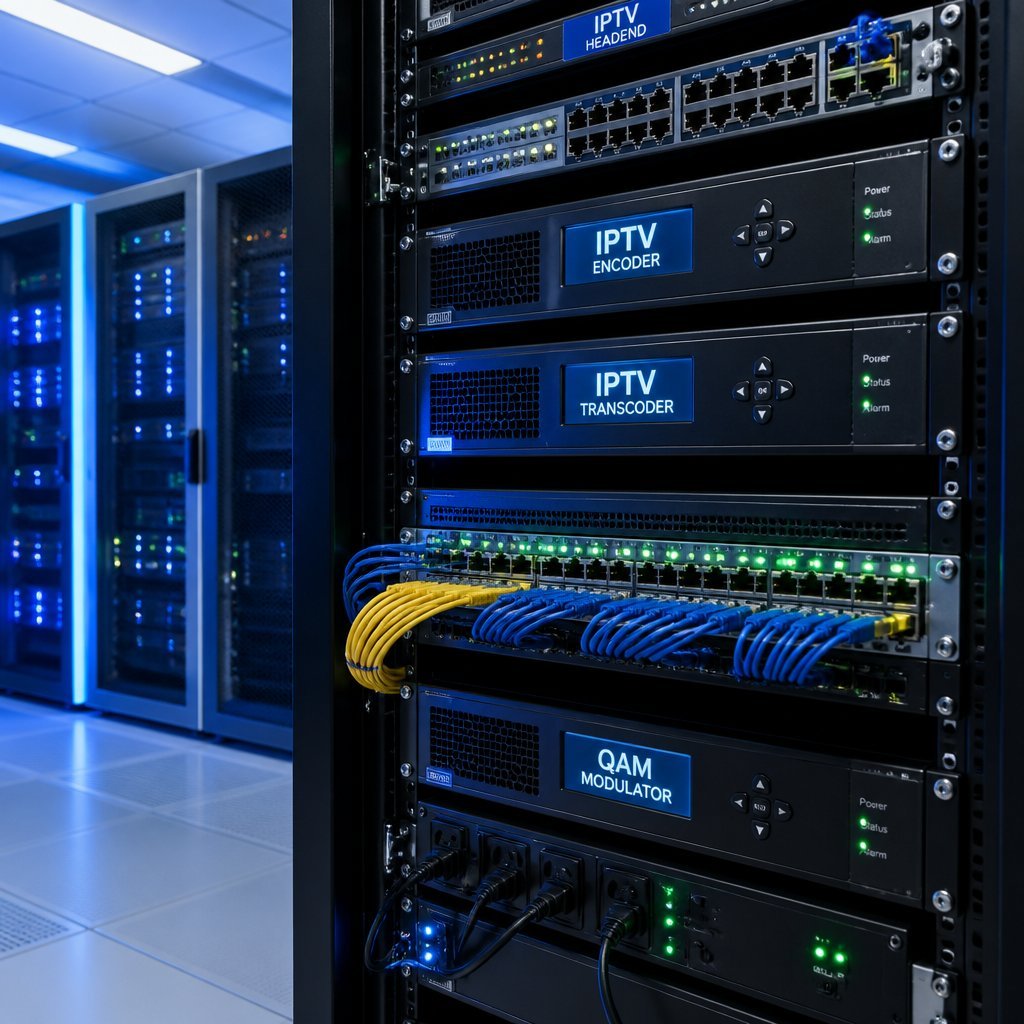
Main Components of an IPTV Headend
Below is a breakdown of the essential building blocks in any IPTV Headend system:
- Reception Equipment – Satellite dishes, LNBs, and antennas for capturing raw signals.
- IRDs (Integrated Receiver Decoders) – Decode satellite/cable signals into baseband video.
- Encoders/Transcoders – Compress and convert video into IP-friendly formats.
- Multiplexers – Combine multiple channels into single transport streams.
- Middleware Platform – Manages EPG, subscriber data, and user interface logic.
- Streaming Servers – Deliver content via multicast/unicast protocols.
- CAS/DRM Modules – Secure premium and pay-per-view content.
- Storage Arrays – Support VOD, catch-up TV, and recording features.
- Network Switches – Manage internal data flow between headend components.
- CDN Integration – Extend delivery reach and reduce latency for remote viewers.
Blockquote Tip: A headend is only as strong as its weakest link. Poor encoding settings or an undersized network switch can bottleneck an otherwise powerful system.
IPTV Headend Equipment List
| Equipment | Function | Importance | Recommended Use |
|---|---|---|---|
| Satellite Receiver (IRD) | Captures and decodes satellite signals | Critical | Free-to-air and encrypted satellite channels |
| Encoder | Compresses raw video (H.264/H.265) | Critical | Live channel encoding |
| Transcoder | Converts bitrate/resolution for multiple devices | High | Adaptive streaming for mobile/TV |
| Multiplexer | Combines multiple streams | High | Channel bundling |
| Middleware Server | Manages EPG, users, and UI | Critical | Subscriber management |
| Streaming Server | Delivers multicast/unicast content | Critical | Live TV and VOD delivery |
| DRM/CAS System | Encrypts and protects content | High | Premium/paid channels |
| Storage Server | Stores VOD and recordings | Medium-High | Catch-up TV, nDVR |
| Network Switch | Routes internal traffic | Critical | Core network backbone |
| CDN | Distributes content globally | High | Scaling to remote viewers |
IPTV Headend Workflow
The complete process from content acquisition to viewer playback follows these steps:
- Content Acquisition – Signals are received from satellite, cable, or IP sources.
- Signal Processing – Demodulation and decoding prepare the raw feed.
- Encoding – Video is compressed into H.264/H.265 formats.
- Transcoding – Multiple bitrate versions are created for adaptive streaming.
- Multiplexing – Channels are bundled into transport streams (MPEG-TS).
- Middleware Integration – EPG, metadata, and subscriber data are attached.
- Encryption – DRM/CAS systems secure premium content.
- Distribution – Streaming servers push content via multicast/unicast.
- CDN Delivery – Content is cached and delivered through edge servers.
- Client Playback – End-user apps decode and display the stream.
IPTV Headend vs OTT Platform
| Feature | IPTV Headend | OTT Platform |
|---|---|---|
| Network Type | Managed private IP network | Public internet |
| Delivery Method | Multicast + Unicast | Primarily Unicast |
| Quality Control | High (dedicated network) | Variable (depends on internet) |
| Typical Use Case | ISPs, hotels, enterprises | General public streaming |
| Infrastructure Cost | Higher upfront investment | Lower upfront, scalable cloud cost |
| Content Security | Strong (dedicated DRM/CAS) | Strong but internet-exposed |
IPTV Headend vs Traditional Cable TV
Traditional cable TV relies on coaxial infrastructure and dedicated broadcast frequencies, while an IPTV Broadcast System uses IP networks for delivery. This shift brings major advantages:
- Flexibility – IPTV can deliver content over existing internet infrastructure.
- Interactivity – EPGs, VOD, and catch-up TV are easier to implement.
- Cost Efficiency – No need for dedicated coaxial cabling across large areas.
- Scalability – Easier to add channels and features without hardware overhauls.
However, cable TV still offers advantages in areas with limited broadband infrastructure, where dedicated coaxial networks remain more reliable than shared IP networks.
Benefits of IPTV Headend Systems
- Scalability – Easily add channels, VOD libraries, and new subscribers.
- Cost Efficiency – Reduces long-term distribution costs compared to satellite/cable-only setups.
- Flexibility – Supports live TV, VOD, catch-up, and interactive services.
- Better Content Management – Centralized control over channels, EPG, and subscriber access.
- Improved Security – DRM and CAS systems protect premium content from unauthorized access.
- Multi-Device Support – Content reaches smart TVs, mobiles, and web browsers simultaneously.
Challenges and Common Problems
- High Initial Investment – Professional-grade encoders, servers, and middleware require significant capital.
- Bandwidth Management – Poorly planned multicast/unicast balance can cause buffering.
- Technical Complexity – Requires skilled engineers for setup and maintenance.
- Content Licensing – Acquiring legal rights to broadcast channels can be complicated and costly.
- Security Risks – Weak DRM implementation can expose content to piracy.
- Scalability Bottlenecks – Undersized network switches or storage can limit growth.
Pro Tip: Always over-provision your network switches and storage by at least 20-30% to accommodate future subscriber growth.
Best IPTV Headend Solutions in 2026
The market includes both commercial and open-source options, each suited to different budgets and technical needs.
Commercial Solutions typically offer full-service support, integrated DRM, and enterprise-grade middleware — ideal for telecom operators and large hospitality chains that need guaranteed uptime and vendor support.
Open-Source Solutions offer flexibility and lower upfront costs but require in-house technical expertise for setup, maintenance, and security hardening. These are often chosen by smaller ISPs, educational institutions, or tech-savvy businesses building custom systems.
When evaluating providers, prioritize:
- Compatibility with H.265/HEVC encoding standards.
- Strong DRM/CAS integration.
- Proven scalability for your subscriber base.
- Responsive technical support (for commercial options).
IPTV Headend for Hotels
Hotels use IPTV Headend systems to deliver in-room entertainment, welcome messages, and hotel information alongside standard TV channels. Benefits include:
- Centralized channel management across all rooms.
- Custom branding and guest information screens.
- Integration with hotel property management systems (PMS).
- VOD libraries for movies and entertainment.
IPTV Headend for ISPs
Internet Service Providers deploy IPTV Headend systems to offer bundled TV services alongside broadband packages. This requires:
- High-capacity multicast networks for live channel delivery.
- Subscriber management middleware for billing and access control.
- Regional CDN nodes to reduce latency across service areas.
IPTV Headend for Universities
Universities use IPTV systems for campus-wide content distribution, including:
- Educational channel broadcasting.
- Emergency alert systems via TV screens.
- Digital signage integration across campus buildings.
IPTV Headend for Hospitals
Hospitals implement IPTV Headend systems to provide patient entertainment and information services, including:
- Bedside entertainment systems.
- Health education channels.
- Integration with hospital information systems for patient-specific content.
IPTV Headend Cost Breakdown
| Cost Category | Estimated Range | Notes |
|---|---|---|
| Satellite Receivers/IRDs | $500 – $3,000 per unit | Depends on channel encryption type |
| Encoders/Transcoders | $2,000 – $15,000+ | Varies by channel count and codec support |
| Middleware Licensing | $5,000 – $50,000+/year | Depends on subscriber scale |
| Streaming Servers | $3,000 – $20,000 | Based on concurrent stream capacity |
| DRM/CAS Integration | $10,000 – $100,000+ | Enterprise-grade security costs more |
| Network Infrastructure | Varies widely | Switches, fiber, and cabling |
Pro Tip: Budget for ongoing maintenance and licensing renewals — many providers underestimate long-term operational costs versus initial setup.
How to Build an IPTV Headend
A beginner-friendly step-by-step approach:
- Define Your Scope – Determine channel count, subscriber base, and delivery method (multicast/unicast).
- Choose Signal Sources – Decide between satellite, cable, or IP-based feeds.
- Select Encoding Equipment – Choose encoders supporting H.264/H.265 for efficiency.
- Set Up Middleware – Implement subscriber management, EPG, and billing integration.
- Configure Streaming Servers – Set up multicast for live TV and unicast for VOD.
- Implement DRM/CAS – Secure premium content with proper encryption.
- Test Network Capacity – Ensure bandwidth supports peak concurrent viewership.
- Launch and Monitor – Continuously monitor QoS metrics and adjust as needed.
Checklist for Building an IPTV Headend
- Signal sources identified and secured
- Encoding/transcoding equipment selected
- Middleware platform configured
- Streaming servers tested for load capacity
- DRM/CAS implemented
- Network bandwidth verified
- CDN integration planned (if scaling regionally)
- Security protocols reviewed
Security Best Practices
- Use strong DRM and CAS systems to prevent unauthorized content access.
- Regularly update middleware and server software to patch vulnerabilities.
- Implement network segmentation to isolate headend infrastructure.
- Monitor for unusual streaming patterns that may indicate credential sharing or piracy.
- Follow encryption standards aligned with DVB and ETSI recommendations.
Future of IPTV Headend Technology
The future of IPTV Headend systems is shaped by advances in compression standards, cloud infrastructure, and AI-driven content management. Key trends include:
- Cloud-Based Headends – Shifting hardware-based processing to scalable cloud infrastructure.
- AI-Powered Content Management – Automated metadata tagging and personalized EPGs.
- Wider H.265/HEVC and AV1 Adoption – Improved compression efficiency for higher-quality streams at lower bandwidth.
- Edge Computing Integration – Reducing latency by processing content closer to viewers.
Organizations such as DVB (Digital Video Broadcasting), MPEG, ETSI, and the IETF continue to develop standards that shape how IPTV Headend systems evolve, ensuring interoperability and efficiency across the industry.
Frequently Asked Questions
1. What is an IPTV Headend?
An IPTV Headend is a system that receives, processes, and distributes television content over IP networks.
2. What equipment is needed for an IPTV Headend?
Key equipment includes satellite receivers, encoders, transcoders, middleware, streaming servers, and DRM systems.
3. How does IPTV differ from OTT?
IPTV typically runs on managed private networks, while OTT delivers content over the public internet.
4. What is IPTV Middleware?
Middleware is the software layer managing EPG, subscriber authentication, and content organization.
5. Why is H.265/HEVC important for IPTV?
It offers better compression efficiency, reducing bandwidth needs while maintaining video quality.
6. Can small businesses build their own IPTV Headend?
Yes, though it requires technical expertise and investment in encoding, middleware, and network infrastructure.
7. What is the difference between multicast and unicast?
Multicast delivers one stream to multiple viewers simultaneously; unicast creates individual streams per viewer.
8. How much does an IPTV Headend cost?
Costs vary widely, from a few thousand dollars for small setups to hundreds of thousands for enterprise-grade systems.
9. What is DRM in IPTV?
Digital Rights Management protects content from unauthorized access through encryption and licensing controls.
10. Do hotels need a full IPTV Headend?
Hotels typically need a scaled-down version focused on in-room entertainment and guest services.
11. What role does a CDN play in IPTV?
A CDN distributes content across regional servers, reducing latency and improving stream reliability.
12. Is IPTV Headend technology future-proof?
With cloud integration and evolving codecs, headend systems are continuously adapting to new technology standards.
13. What network requirements are needed for IPTV?
Reliable, high-bandwidth networks with proper multicast support are essential for smooth delivery.
14. Can universities benefit from IPTV Headend systems?
Yes, for educational broadcasting, digital signage, and campus-wide communication.
15. What are the main IPTV Headend architecture layers?
Signal sources, encoders/transcoders, middleware, streaming servers, storage, DRM, and CDN.
Final Conclusion
An IPTV Headend is the backbone of any successful IPTV deployment, transforming raw broadcast signals into secure, scalable, IP-based content delivery. From hotels and hospitals to ISPs and universities, understanding the architecture, equipment, and workflow behind an IPTV Headend system is essential for anyone building or managing a modern television distribution network.
As technology evolves with better compression standards, cloud infrastructure, and AI-driven management, investing in a well-designed IPTV Headend system positions organizations for long-term success in digital content delivery.